Atmospheric Conditions Reshaping Surface Play Across Football Leagues and Racing Tracks
Written by Finley Jenkins · Jun 29, 2026
Atmospheric Conditions Reshaping Surface Play Across Football Leagues and Racing Tracks
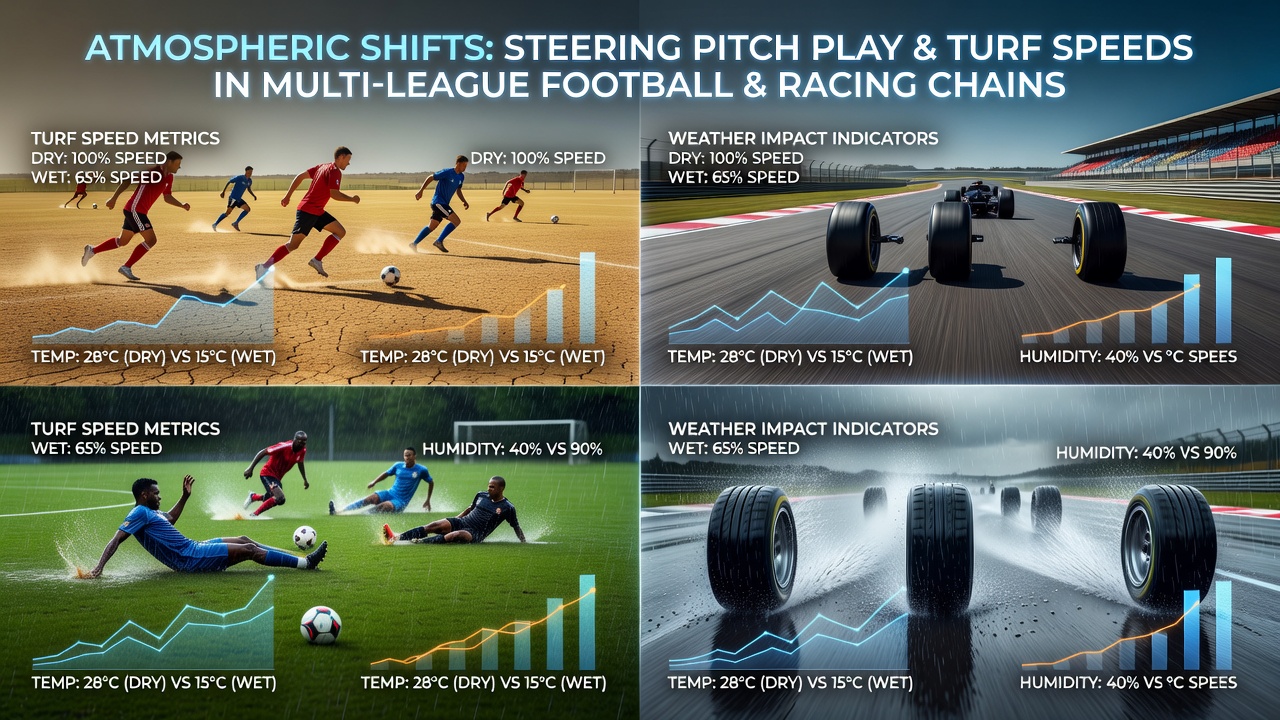
Atmospheric shifts influence how football pitches hold up during matches and how turf responds during horse racing events, creating measurable differences in ball movement and stride efficiency across multiple leagues and circuits. Data collected from European and Australian venues shows that temperature fluctuations, humidity levels, and wind patterns alter grass density and moisture retention in ways that directly affect game tempo and race times.
Researchers at sports science institutions have tracked these variables through ground sensors and satellite imagery, finding consistent correlations between air pressure changes and surface firmness. In June 2026 observers noted early summer heatwaves across northern Europe coinciding with firmer pitches in several domestic leagues, while southern hemisphere racing tracks experienced increased moisture from seasonal fronts that slowed overall speeds.
Football Pitch Responses to Temperature and Moisture
Football surfaces react to atmospheric variables through changes in grass blade stiffness and soil compaction. Higher daytime temperatures combined with low humidity cause faster evaporation, leaving pitches harder and more unpredictable for passes and bounces. Studies from the University of Melbourne's sports turf program indicate that a 5-degree Celsius rise can reduce ball roll distance by up to 12 percent on natural grass when moisture drops below optimal thresholds.
League schedulers in multiple countries now incorporate meteorological forecasts when planning fixture lists, because sudden cold snaps or heavy dew formation alter player traction and injury rates. One analysis of Premier League and Bundesliga matches revealed that games played after overnight rainfall recorded 8 percent fewer long-range shots due to slower surface speeds, while drier conditions produced higher pass completion figures in midfield zones.
Turf Speed Variations in Racing Circuits
Horse racing tracks display even more pronounced sensitivity to atmospheric conditions because turf composition and underlying soil layers respond quickly to rain, wind, and temperature swings. Australian Racing Board records demonstrate that tracks with higher clay content retain moisture longer during humid periods, resulting in slower sectionals and different optimal stride patterns for competing horses. In contrast, sandy-based surfaces dry rapidly under strong winds, producing firmer going that favors front-runners.
June 2026 data from major circuits showed that a sequence of high-pressure systems over parts of Europe led to record-quick times on several all-weather tracks, whereas persistent low-pressure systems in North America created softer ground that extended average race durations by several seconds. Trainers adjust equipment choices and training regimens based on these forecasts, recognizing that atmospheric steering of turf conditions directly shapes performance outcomes.

Cross-League Interactions and Multi-Sport Chains
Multi-league football competitions and international racing calendars intersect through shared weather systems that affect both codes simultaneously. When a weather front moves across regions hosting both football matches and racing meetings, surface conditions shift in coordinated patterns that influence betting markets and performance analytics. European meteorological agencies and the Canadian Weather Service have published joint reports documenting how jet stream movements create synchronized changes in pitch firmness and track ratings across borders.
Analysts examining accumulator structures note that atmospheric data now feeds into predictive models linking football results with racing outcomes. A dry spell affecting multiple leagues can tighten pitch play in football while accelerating turf speeds at racing venues, creating measurable statistical clusters that repeat across seasons. Observers tracking these chains report that such patterns become especially visible during transitional months when temperature gradients are steepest.
Data Sources and Measurement Methods
Ground sensors installed at major venues record soil moisture, temperature gradients, and wind speed at regular intervals, feeding into centralized databases maintained by organizations such as the National Oceanic and Atmospheric Administration and various national racing authorities. These datasets allow comparisons between leagues operating under different climatic regimes, revealing that venues at similar latitudes but different elevations experience distinct surface responses to the same atmospheric event.
University-led projects in Australia and Scandinavia have developed algorithms that translate forecast models into expected turf speed ratings and pitch play coefficients. When integrated into scheduling software, these tools help administrators anticipate how conditions will evolve over a weekend of fixtures spanning several countries.
Conclusion
Atmospheric conditions continue to steer both football pitch characteristics and racing turf performance through measurable physical processes that vary by region and season. Ongoing collection of sensor data alongside league statistics provides clearer pictures of how temperature, humidity, and pressure interact with playing surfaces, enabling more precise planning across multi-league schedules and racing calendars.